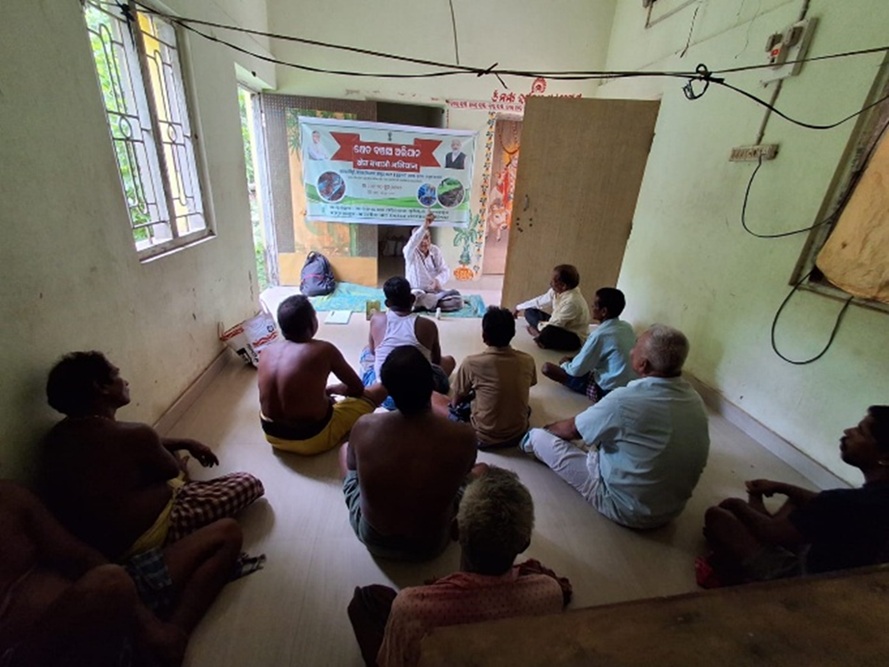
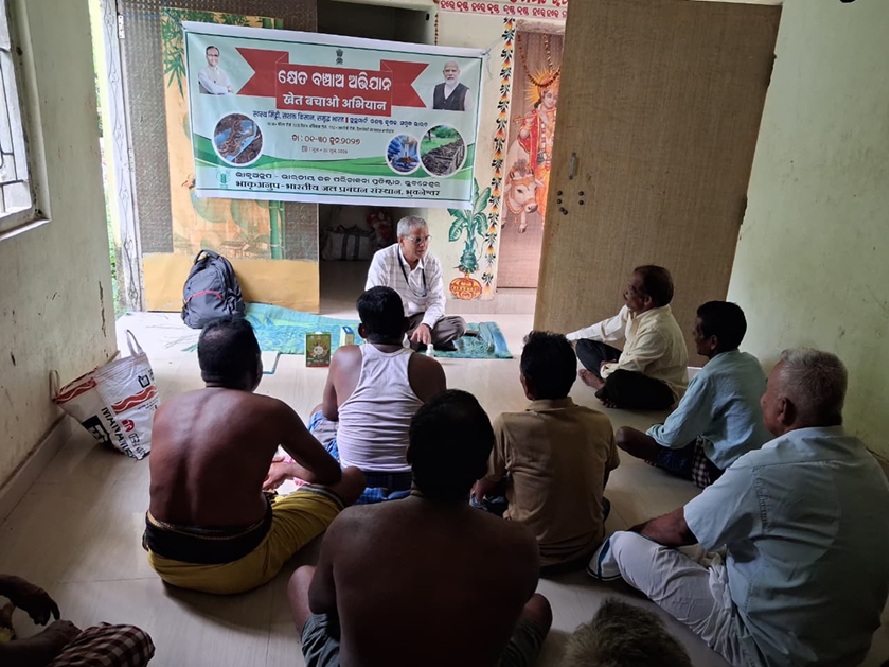
An awareness-cum-demonstration programme under the Government of India’s “Khet Bachao Abhiyan” was organized at Barkuda village under Nimapara Block of Puri district, Odisha. The farmer–scientist interaction programme was conducted by scientists from ICAR–Indian Institute of Water Management (IIWM), Bhubaneswar, with the active participation of 28 farmers. The programme focused on promoting sustainable soil and water management practices, balanced nutrient use, and climate-resilient agriculture for enhancing farm productivity and profitability. Farmers were sensitized on the objectives of the Khet Bachao Abhiyan and the importance of conserving soil and water resources for long-term agricultural sustainability. Discussions were held on integrated nutrient management through the judicious use of chemical fertilizers, organic manures, crop residues, green manures, and biofertilizers to improve soil fertility, nutrient-use efficiency, and crop productivity. Farmers were encouraged to adopt soil-test-based fertilizer application and make effective use of Soil Health Cards for scientific nutrient management. The importance of secondary and micronutrients in achieving balanced crop nutrition and sustaining crop yields was also highlighted. Information was provided on digital agriculture platforms such as Plantix and Bharat Vistaar, which can support farmers through crop diagnosis, pest and disease identification, weather-based advisories, and access to scientific agricultural information. The programme also emphasized the role of collective action and community participation in enhancing agricultural resilience. A success story from a flood-affected region was shared, where farmers successfully restored crop production through timely access to short-duration rice varieties, technical guidance from scientists, and mutual cooperation in sharing farm machinery and resources. Despite severe crop losses caused by flooding, the coordinated efforts enabled farmers to achieve yields and returns comparable to a normal season. Participants were encouraged to strengthen cooperation among themselves and actively participate in Farmer Producer Organizations (FPOs) to improve access to inputs, technologies, markets, and institutional support. The programme concluded with an interactive discussion session during which farmers shared their field-level experiences and discussed challenges related to soil fertility, nutrient deficiencies, water management, and crop production. The scientists addressed their queries and encouraged the adoption of balanced fertilization, resource-conserving technologies, and eco-friendly agricultural practices for sustaining soil health, improving resource-use efficiency, and enhancing long-term agricultural productivity.